
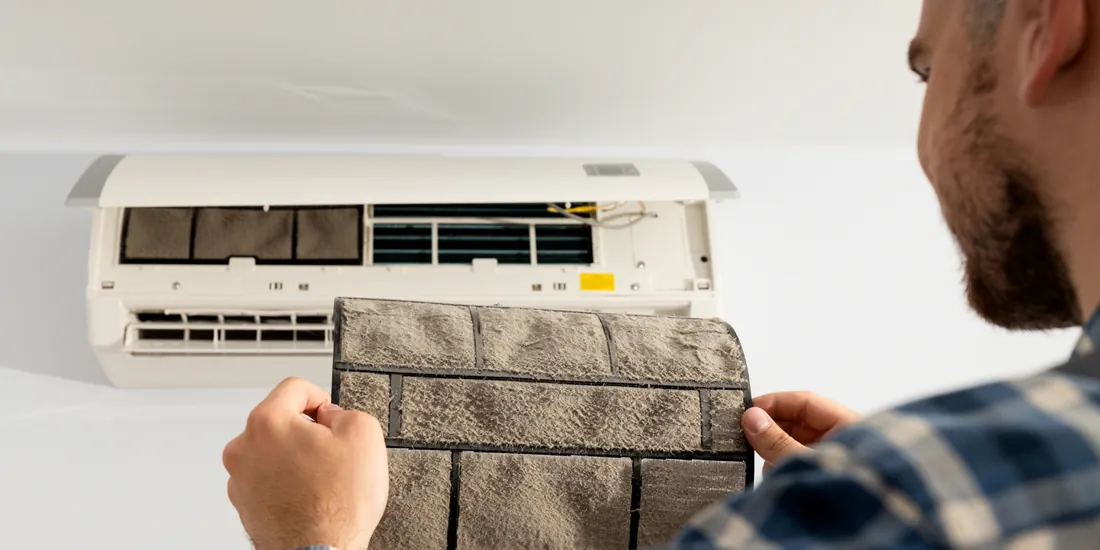
A Newark heat wave is no time for an AC that hums along without actually cooling. The frustrating part is that the unit seems to be working, the fan’s on, you hear it running, but the air coming out is room temperature or worse. Sometimes the cause is something you can fix in five minutes. Sometimes it needs a tech. Here’s how to tell which.
1. Check the thermostat
It sounds obvious, but it’s the most common “repair” we don’t need to make. Confirm it’s set to Cool (not just Fan), the temperature is set below the current room temp, and the batteries aren’t dead. If the fan setting is on “On” instead of “Auto,” the blower runs constantly, even when the system isn’t actively cooling, which feels like warm air from the vents.
2. Replace a dirty air filter
A clogged filter is the number-one cause of weak cooling. It strangles airflow, which drops performance and can even freeze the coil. If your filter looks gray and fuzzy, swap it. This single step solves a shocking number of “my AC is broken” calls, and you should be changing it every 1–3 months anyway.
3. Look for ice on the unit or lines
If you see frost or ice on the refrigerant line or the indoor coil, the system can’t cool, and running it that way risks the compressor. Turn it off and let it fully thaw (a few hours). Ice usually points to either low refrigerant or starved airflow (see #2). If it comes back after thawing, you need a tech.
4. Check the breaker
Central systems often have two breakers, one for the indoor air handler and one for the outdoor condenser. If the outdoor unit isn’t running at all, a tripped breaker is a prime suspect. Reset it once. If it trips again, stop, that’s an electrical fault that needs professional attention, not repeated resetting.
5. Clear the outdoor condenser
The outdoor unit dumps your home’s heat into the air, and it can’t do that if it’s choked. Make sure there’s at least a couple of feet of clearance, and that grass, leaves, cottonwood fluff or debris aren’t caked into the fins. Gently rinse the outside of the coil with a hose (power off) if it’s grimy.
6. Check the condensate drain
Many systems have a safety switch that shuts off cooling if the condensate drain backs up, to prevent water damage. If your AC suddenly stopped and you see water near the indoor unit, a clogged drain may have tripped that switch.
7. Listen for the compressor
Stand by the outdoor unit. Is the fan spinning and do you hear the compressor running, or just a hum or click and nothing? A unit that buzzes but won’t start is a classic failed-capacitor symptom. That’s a common, affordable repair, but it’s a tech’s job, capacitors store a dangerous charge even with the power off.
8. Consider refrigerant (this one’s ours)
If airflow is fine, the filter’s clean and the unit still blows warm, low refrigerant from a leak is a likely culprit. This isn’t a DIY fix, and it’s not a simple “top-off.” The system is sealed, so low refrigerant means there’s a leak that has to be found and repaired before recharging. We’ll handle that part.
When to call us
If you’ve checked the thermostat, filter, breaker and outdoor unit and you’re still getting warm air, or if you saw ice, heard the compressor struggle, or smelled anything burning, it’s time. Those point to refrigerant, electrical or compressor issues that need tools and training.